Eight things to check before you place your first order — from body construction to the documents most buyers forget to ask for.
Sourcing stainless steel cookware looks simple on a quotation sheet: material, thickness, size, price. The difference between a supplier that survives three repeat seasons and one that fails on the second shipment is almost always hidden in what the quotation does not say — how the multi-ply body is bonded, what surface treatment is actually applied, who really owns the production line, and which documents exist on paper versus in reality.
This guide is written for importers, private-label brand owners and food-service buyers comparing factories in China. It reflects what our team in Zhejiang sees on the shop floor every day, and it deliberately includes the questions that a genuinely capable factory will answer happily — and a trader cannot.
Factories specialise. A plant that is excellent at bonded tri-ply saucepans is not automatically good at deep-drawn stockpots, hammered woks or PVD finishes. Before sending RFQs, fix these four variables — they determine which type of factory you should be talking to:
Sending "please quote your stainless steel cookware" to fifteen factories produces fifteen generic quotations and no useful comparison. Sending a defined spec produces three serious answers.
Price differences of 30–50% between two outwardly identical pans usually come from the wall structure and the bonding method. Compare like with like:
| Structure | Typical build | Heat behaviour | Price level | Best for |
|---|---|---|---|---|
| Single-layer | 1× 0.4–0.6 mm stainless | Hot spots, fast response | Lowest | Promotional sets, price channels |
| Two-layer (clad bottom) | Stainless body + aluminium disc base | Even base, thinner walls | Low | Entry retail, large stockpots |
| Tri-ply | 304 / Al / 430 through full wall | Even heating wall and base | Mid | Mainstream retail and food service |
| 5-layer with copper core | 304 / Al / Cu / Al / 430 or similar | Fast, very even response | High | Premium brands, chef ranges |
Ask specifically about the bonding method: impact bonding presses layers together at high pressure and requires different equipment than roll-bonded clad sheet. Factories that bond in-house can vary thickness and layer order; factories that buy pre-clad sheet cannot. This single question tells you a great deal about flexibility and cost structure.
The surface finish determines cleaning behaviour, durability claims, and which markets you can legally sell into. There is no universally best option — there is only the right option for your channel:
| Treatment | Non-stick effect | Durability | Notes for buyers |
| Bare stainless (mirror / satin / hammered) | None | Excellent | Simplest compliance story; needs honest cooking guidance |
| Honeycomb laser etching | Partial (raised pattern protects food) | Excellent | Popular premium look; pattern depth affects performance |
| PTFE / ceramic non-stick coating | High | Limited lifecycle | Check coating supplier and film thickness; restricted claims in some markets |
| PVD copper / gold finish | None | Very good | Vacuum-deposited, decorative, metal-bonded layer |
| Inorganic nano film (e.g. MARSCOAT®) | Moderate and water-assisted | Very good | 2–5 μm, cured 190–290 °C; verify adhesion grade in a report |
Whatever you choose, ask for the test method, not just the claim. For any bonded or applied layer, the cross-cut adhesion test is the baseline: Class 0 according to GB/T 9286-2021 (5B under ASTM D3358) is the top result. If a supplier cannot name the standard their "excellent adhesion" came from, treat the claim as marketing.
A surprising share of "factories" online are trading companies with good photography. None of the following checks is difficult; together they are conclusive:
Most sourcing disputes come from documents requested too late. Send this list with your first RFQ:
A factory that works with export markets every day will return most of these within a day. Long silences at this stage are themselves information.
Plan around these figures rather than best-case promises:

The cheapest FOB price is frequently not the cheapest landed cost. Before deciding, convert every quotation to the same basis: unit price + tooling amortisation + packaging + inland transport + freight + duty + defect risk. A supplier with a documented three-gate inspection (incoming material, in-process, pre-shipment) usually costs a little more per unit and considerably less per complaint.
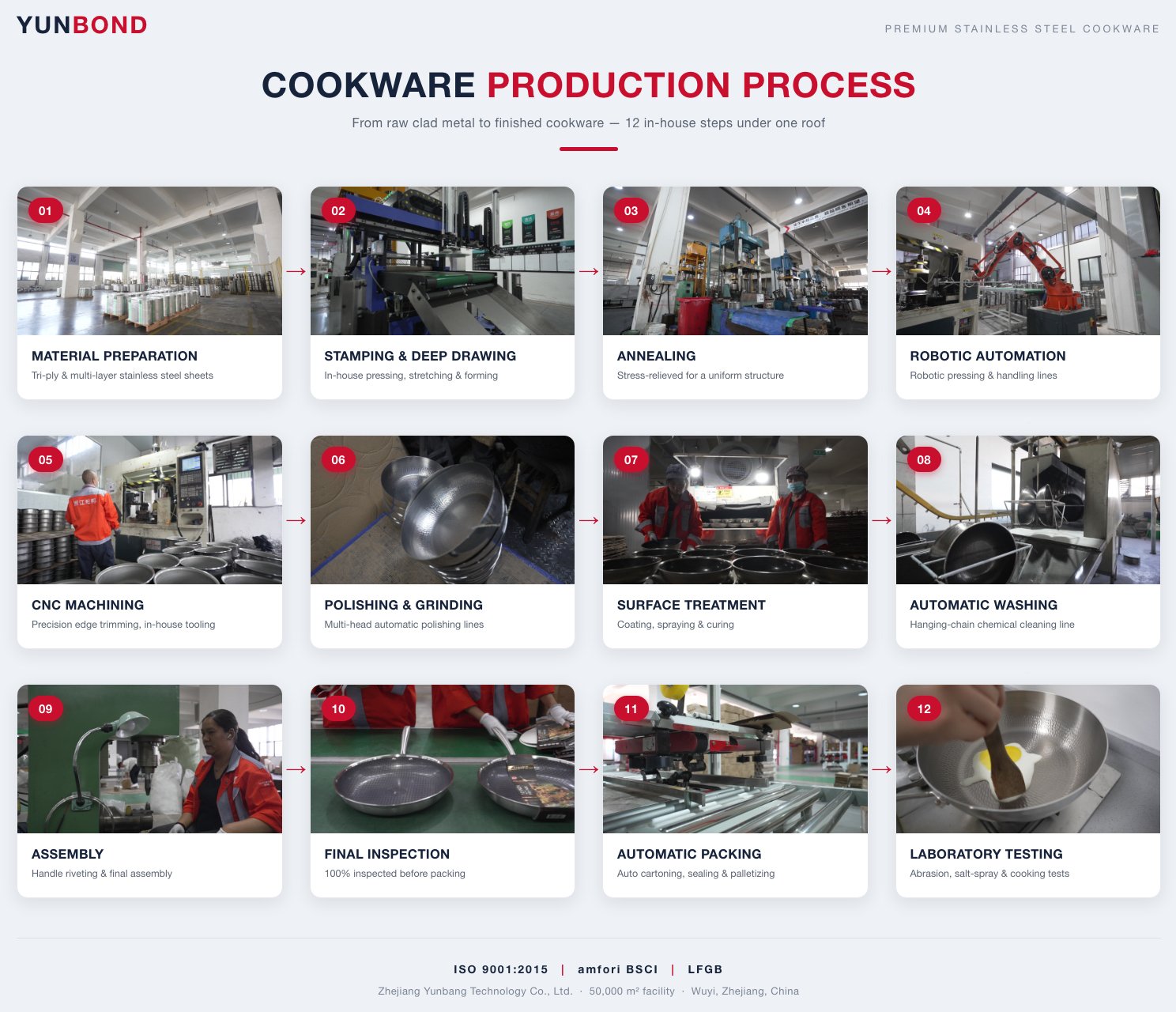
YUNBOND (Zhejiang Yunbang Technology Co., Ltd.) is a stainless steel cookware manufacturer in Wuyi County, Zhejiang, with a 50,000 m² plant founded in 2020 and a team carrying 17 years of cookware manufacturing experience. We bond and form in-house, operate laser etching and PVD lines, and are a licensed applicator of MARSCOAT® inorganic nano film technology. We hold ISO 9001, an amfori BSCI audit and LFGB testing; SGS and CTI performance reports are published on this site rather than offered only on request.
If you are comparing options right now, the fastest way to get a real answer is to send us three things: target format and size range, target market (for compliance), and expected annual volume. We will reply with build options, realistic MOQ and a timeline — not a generic price list.
Tell us the format, target market and volume. You will get construction options, an honest MOQ and a timeline within 24 hours.
Request a quote Browse 64 SKUsRelated reading: MARSCOAT® nano film technology and test data · inside our factory and inspection gates · OEM / ODM process · more sourcing FAQs