
Layer stacks, wall thickness, interior treatments, induction compatibility and price bands — how to compare the three constructions suppliers quote most often.
Ask five factories to quote “tri-ply stainless steel cookware” and you will get five prices differing by 40% or more. The gap is rarely about steel: it comes from wall thickness, bonding method and interior treatment — and from the word on the box not matching the structure inside the wall.
For importers, brand owners and food-service buyers this is not a technical footnote: the body structure sets your landed cost, retail price ceiling, return rate and compliance workload for the life of the programme. This guide translates the three names you will be quoted — tri-ply, 5-ply and “titanium” — into the specifications on a production drawing, using builds we run in Wuyi County, Zhejiang.
A ply is a layer. Tri-ply means three layers bonded through the wall and the base; 5-ply means five. That is everything the word guarantees. It says nothing about:
So before two quotations can be compared, reduce each to four numbers: layer stack, total thickness, interior treatment, size range. Do that and the 40% gap explains itself.
The standard build is a 304 cooking surface, an aluminium core and a 430 base, bonded through the full wall rather than as a base disc alone — so heat spreads up the side of the pan instead of scorching at the centre.
Tri-ply also offers the widest interior choice, which is why it dominates export catalogues. In our range, tri-ply bodies run at 2.0–2.2 mm, covering 16 cm milk pans through 32 cm woks and full 16–32 cm set programmes:
Across our 64-SKU catalogue, tri-ply is the largest group — 20 SKUs in classic polished and sanded finishes, 27 honeycomb-etched. That split reflects where market volume sits.
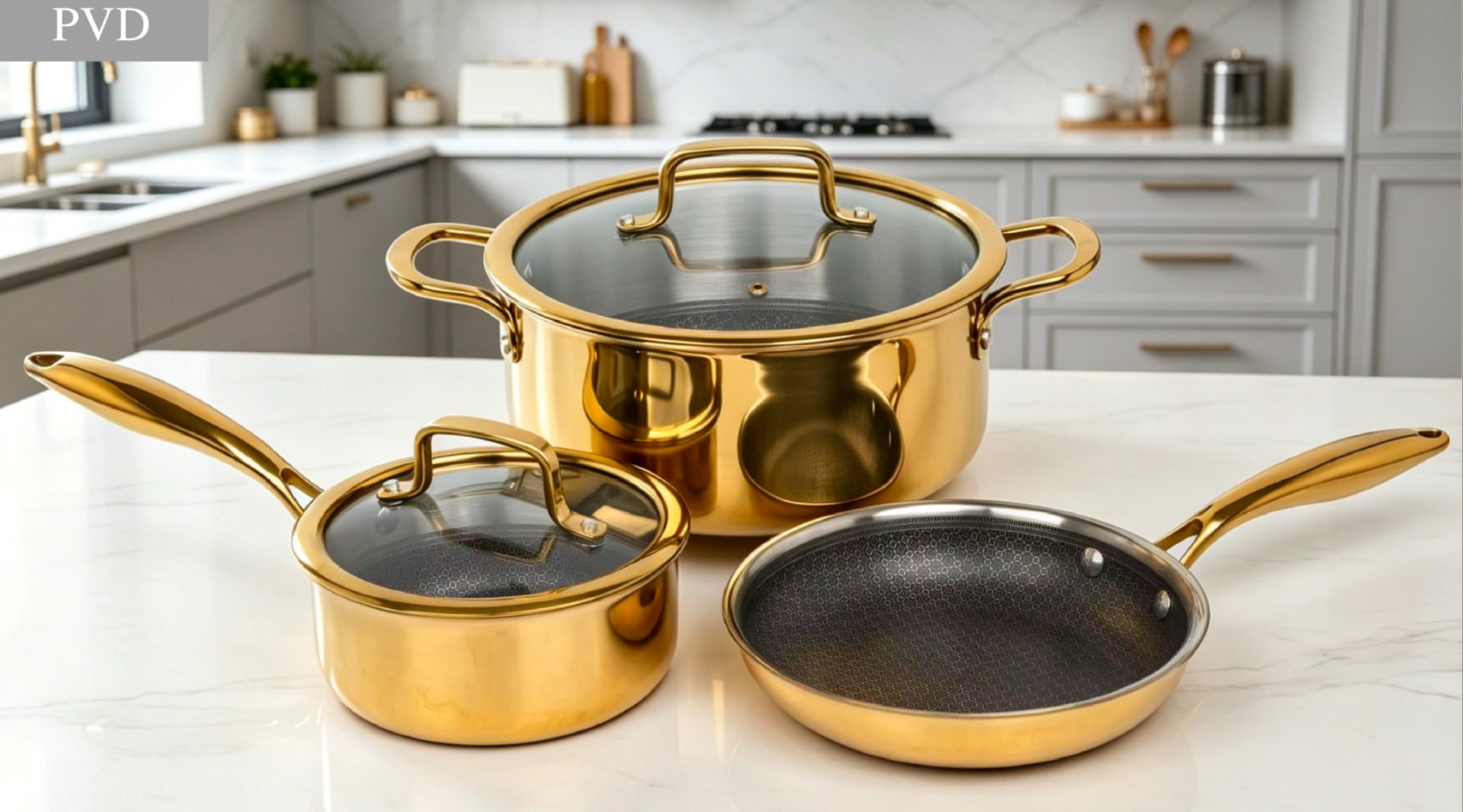
A five-layer build adds copper and further aluminium layers to the stack. In our PVD copper series the body is 5-layer stainless steel copper at 2.5 mm: a 304 food-contact surface, aluminium core layers, a copper response layer and a 430 magnetic base for induction. The exterior carries a vacuum-deposited PVD copper or rose-gold tone.
Buyers should separate two things that are often sold as one:
Price position is high, for three reasons: thickness rises from 2.0–2.2 mm to 2.5 mm, copper is expensive per kilo, and PVD adds a process step. We run 7 SKUs in this series, all at 2.5 mm with a ceramic interior. If your channel cannot carry the implied retail price, the copper layer is the first thing to drop.
Titanium cookware is not one product. The word covers at least three different things, and buyers are often quoted one and shipped another:
So the useful question is not “is it titanium?” but “which layer contains titanium, how thick is it, and what is it bonded to?” When the answer is vague, the word is doing marketing work.
In our catalogue, Tri-Ply Titanium is defined precisely: a tri-ply body at 2.3 mm with either a coating-free hammered finish or a titanium non-stick coating, in sizes from 16 cm to 34 cm, across ten SKUs. Stated plainly, it is a tri-ply stainless body with a titanium-bearing surface system, not a solid-titanium pan — and we would rather say so on the quotation than argue after shipment.
The table below uses builds we produce, so every figure is quotable rather than a category average.
| Attribute | Classic tri-ply | Honeycomb-etched tri-ply | 5-ply copper core (PVD) | Tri-Ply Titanium |
|---|---|---|---|---|
| Layer stack | 304 / aluminium core / 430 | 304 / aluminium core / 430 | 304 / Al core layers / Cu / 430 + PVD exterior | Tri-ply stainless body, titanium surface system |
| Total thickness | 2.0–2.2 mm | 2.0–2.5 mm | 2.5 mm | 2.3 mm |
| Cooking surface | Polished or sanded bare steel | Laser-etched honeycomb, optional non-stick over etch | Ceramic coating | Coating-free hammered, or titanium non-stick |
| Size range | 16–32 cm; woks 28–32 cm | 16–32 cm; woks 28–32 cm | 16–32 cm; fry pan 26 cm | 16–34 cm |
| Induction | Yes — 430 base | Yes — 430 base | Yes — 430 base | Yes |
| Heat behaviour | Even across base and wall | Even, with protected pattern | Fastest response, best recovery | Even; hammered finish aids release |
| Non-stick claim | None | Partial, or coated variant | Ceramic coating | None (hammered) or titanium non-stick |
| Catalogue SKUs | 20 | 27 | 7 | 10 |
| Price band | Mid | Mid to upper | High | Mid to upper |
| Best channel | Mainstream retail, food service | Premium retail, gifting | Premium and chef ranges | Premium retail, coating-conscious positioning |
Two rows deserve most attention. Thickness drives unit cost and perceived quality — a 2.5 mm pan feels expensive before anyone cooks with it. Non-stick claim drives marketing risk: a coating-free hammered interior carries no claim to defend.
What changes in the kitchen:
For any applied or bonded surface layer, the baseline check is cross-cut adhesion: we cite Class 0 per GB/T 9286-2021 (5B per ASTM D3358), the top grade. Where a nano film is applied, published parameters include a 2–5 μm film cured at 190–290 °C, pencil hardness above 9H (GB/T 6739-2022) and a water contact angle below 10°. The full data set and the SGS and CTI reports behind it are on our MARSCOAT® nano film page.
For market access, the documents we ship with are: ISO 9001:2015 quality management (certificate 30226Q00352R001, valid to 2029-06-29), an amfori BSCI social-compliance audit (DBID 156-041848-000, valid to 2027-06-12), and LFGB food-contact testing by Bureau Veritas (report 3225127-0268, May 2025, all items PASS — lead and cadmium migration assessed against FDA CPG 545.400/545.450). Performance testing is published from SGS and CTI. Every batch passes four inspection gates — incoming material, in-process, finished product and pre-shipment — which you can see documented on our factory and quality page.
The construction changes the commercial terms less than buyers expect, because the MOQ driver is tooling rather than layer count:
One note from experience: the most common delay is not the factory, it is packaging approval — two weeks saved there is worth more than a week shaved off production.
| Your channel or positioning | Recommended build | Why |
|---|---|---|
| Promotional or price-led sets | Classic tri-ply, sanded interior, 2.0 mm | Lowest unit cost that still heats evenly up the wall |
| Mainstream retail with a premium look | Honeycomb-etched tri-ply, 2.2 mm | Shelf appeal and partial release without copper cost |
| Premium or chef range | 5-ply copper core with PVD, 2.5 mm | Thermal response justifies the retail price, and the finish photographs well |
| Coating-conscious or “healthy” positioning | Tri-Ply Titanium, coating-free hammered, 2.3 mm | No coating claim to defend, distinctive hammered look |
| Food service and heavy use | Classic tri-ply, bare steel interior, 2.2 mm | No coating lifecycle to manage; survives commercial kitchens |
When undecided, hold samples: only a sample tells you whether the weight works for your customer.
YUNBOND (Zhejiang Yunbang Technology Co., Ltd.) is a stainless steel cookware manufacturer in Wuyi County, Zhejiang — a 50,000 m² plant founded in 2020, with 17 years of cookware manufacturing experience and 8 years in tri-ply technology. We run laser etching, PVD and automated spraying lines in-house and are a licensed applicator of MARSCOAT® inorganic nano film technology. All four constructions above run on those lines, so we can quote them against each other rather than steering you toward whichever we stock.
Send three things for a usable answer: format and size range, target market for compliance, and expected annual volume. You get build options, an honest MOQ and a timeline.
Tell us format, market and volume — you get construction options and a timeline within 24 hours.
Request a quote Browse all 64 SKUsRelated reading: How to choose a stainless steel cookware manufacturer in China · 64-SKU catalogue · MARSCOAT® test data · PVD copper series · factory and certificates · OEM / ODM process